

Key Takeaways:
- The first five minutes of a pitch are crucial: if you fail to engage your audience with a well-defined and compelling problem, the rest of your presentation might be ignored. The problem should be clear, concrete, and, if possible, conveyed through a compelling story that fosters empathy and curiosity.
- A winning pitch unfolds like an engaging story: it introduces a problem (the initial conflict), builds tension by demonstrating its severity and widespread impact, presents the solution (the turning point), and proves why the team is capable of executing it successfully. Every section—from market size to business model—must answer key investor concerns and reinforce the project’s viability.
- Market metrics, business models, and traction data should be well-structured and easy to understand, avoiding excessive details or overwhelming tables. A pitch must demonstrate a clear strategy for growth, monetization, and customer acquisition while using clean and impactful visuals to support key messages.
Investors hear countless pitches—only the best stand out. A winning pitch must be clear, engaging, and strategic
What are the consequences to failing your next investor pitch?
What happens if you keep failing to get your startup funded, how many more startup pitch presentations can you still afford to fail?
Persuading investors through a startup pitch presentation it’s not an easy thing.
Raising money is the second hardest part of starting a startup. The hardest part is making something people want.
P. Graham
The startup pitch is a high stake presentation.
You are under time pressure, you just get 5 minutes to give an effective presentation and to convince an audience you are worth their investment.
Do you know what complicates the situation?
You won’t be alone!
There will be many other startups out there looking for the same funding and pitching the same investors.
You need to standout from the crowd and conquer your audience.
How to do that?
Simple, you just need an outstanding startup pitch presentation, with an excellent startup pitch structure.
But… What does it make a startup pitch presentation to be a great one?
You need to give investors the information they need to facilitate their decision in a given, short amount of time, and without making them sleep.
There are 3 fundamental pillars to an effective startup pitch structure:
- The contents you include (what you say and what you don’t say)
- The order you present the contents (what you say first)
- The design that brings the contents to life
So, which information do you include in your 5 minutes startup pitch deck and in which order do you plan to to present them?
When I started pitching, I used to browse the internet to find some effective startup pitch structure to follow.
With the experience, I’ve realized that the web offers you many pitch structures for startup presentations but it is hard to say which one will be the best one.
So I decided to extract the pitch structures of hundreds of the most successful pitches ever and to compare them and published a book, Startup Pitch – the ultimate guide to creating a brilliant startup pitch presentation and get funded.

I discovered that all these pitches had something in common and, by doing some statistics, it wasn’t difficult to extract a best practice communication structure.

This is not one more startup pitch presentation structure, this is the unique startup pitch structure that includes hundreds of other successful pitch presentation structures and communication strategies.
I order to enable entrepreneurs to easily work on this structure and quickly make the strategy of their pitch presentations I’ve formalized this knowledge into a one stop shop tool named – Investor Pitch Canvas.
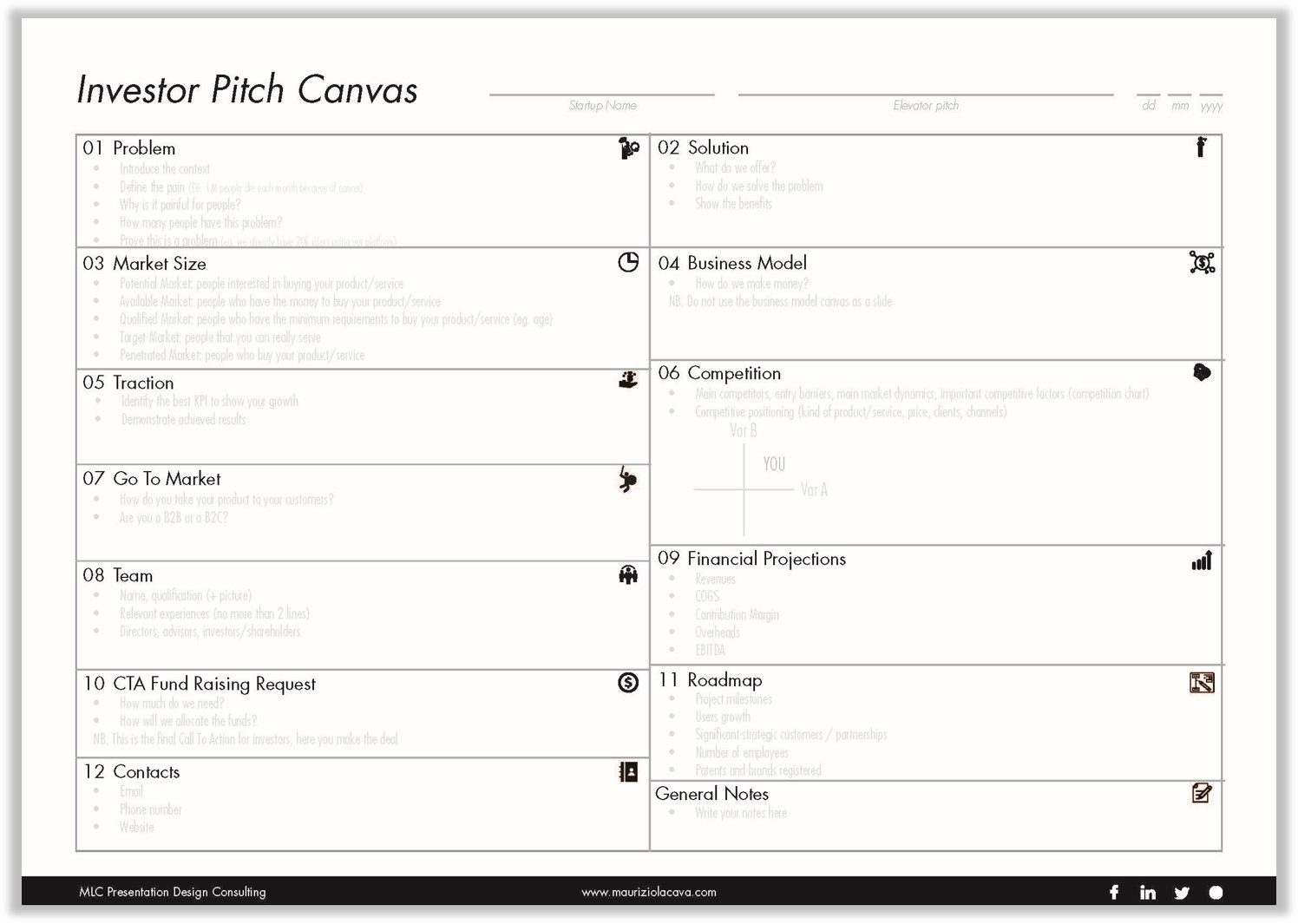
This is the structure to follow to create a startup pitch presentation.
To make the process even more efficient and impactful, you can use tools like our MLC PowerPoint Add-In. This add-in helps you quickly build and design professional-looking slides, ensuring your pitch is visually compelling and aligned with the structure you’ve created.
Read also: Startup Pitch deck: the ultimate guide to create a brilliant startup pitch presentation
How to Start Your Startup Pitch Structure: The Problem
Everything begins with the description of the problem.
Why is it so?
According to Sequoia capital, one of the most common mistakes people make is believing that, if you are given a one-hour meeting, you will get an hour of attention.
In fact, there is a significant drop of attention in the first five minutes of any meeting.

During a pitch presentation, where you are likely not the first speaker of the day, the five minutes allocated may be the only opportunity you have to capture investors’ attention.
This means that failing to make a strong impression from the very beginning could compromise the entire outcome of your presentation. If you are looking for effective ways to start, consider exploring these 13 successful presentation hook ideas.
But why is the opening moment so critical? Why do audiences often lose interest so quickly?
According to P. Coughter, people act egotistically, and are always motivated by their own profits.
Applying this principle to the art of crafting an effective pitch, the best way to capture investors’ attention from the very beginning is to anchor them to a problem that immediately sparks their interest.
If your listeners are directly or indirectly affected by that problem, they will automatically want to know how to fix it.
If your audience isn’t completely aware of the problem, it will be your responsibility to open your presentation by describing the context, introducing the problem and explaining the seriousness of its impact.
Do this right, and you’ll highlight a real economic inefficiency—aka, a huge business opportunity. And trust me, when investors spot that, they’ll start paying attention.
But here’s the deal: if they don’t care about the problem, you’re pitching to the wrong people.
The important thing is that, whomever you are talking to, you can arouse their interest.
Your goal? Get them hooked.
One of the best ways to do that? Storytelling. Every great story starts with conflict, and that’s what keeps people engaged. Want to nail this part? Check out this case study on storytelling techniques for presentations.
Think about it.
Every great story starts the same way—first, you get some context. You’re introduced to the main character, the setting, the situation. And just when you’re settling in, bam! Something happens. That’s the moment everything changes, and the real story begins.
In storytelling, this moment is called the “call to adventure”—the trigger that pulls both the main character and the audience into the journey.
Agrilyst – a platform of intelligent management of indoor farming – at the 2015 Techrunch Disrupt, won the day by this presentation.
Alison starts the presentation by introducing the concept: agriculture is a difficult thing.
She immediately grabbed attention by making it relatable—even the guy growing tomatoes in his backyard deals with the same challenges as professional farmers. She made the audience see themselves in the problem before hitting them with the reality check: greenhouse farming isn’t as easy as people think.
She then built up the tension, outlining the real struggles farmers face, before seamlessly transitioning to her solution. She didn’t just list facts—she told a story, using Tom, the grower, to illustrate the challenge of collecting and interpreting greenhouse data.
By doing this, she hooked the audience before even mentioning her product. She made them feel the problem first, and only then did she introduce the solution.
And she didn’t do it with mere words.
Her slides were clean, simple, and impactful—they brought her story to life and helped investors see, not just hear, what she was talking about.
For startups that want to achieve the same impact, relying on a specialized PowerPoint presentation design agency can make a real difference in terms of clarity, engagement, and visual appeal.
Now, do you see why slides matter so much in a pitch?
With them, Alison immersed investors in her story. She made them feel like they were in the greenhouse with Tom, struggling to make sense of all that data.
Remember, people care about their own interests. That’s just how we’re wired. If you want your pitch to land, start with a problem that matters. Make it real. Make it emotional.
Credibility + emotion = impact.
When people feel the weight of a problem, they naturally want to hear the solution. That’s your opening. Use it wisely, and investors won’t just listen—they’ll lean in.
Startup Pitch Structure Part 2: The Solution
Ever been on a roller coaster, slowly climbing to the top?
That click-click-click as the ride inches upward, your anticipation building—you know the drop is coming, but you have no idea how intense it’ll be. That rush of adrenaline? That’s exactly how you should structure your pitch.
The problem is the climb.
The higher you go, the greater the tension. Your audience leans in, curiosity growing—they want to know where this is leading.
But you can’t just throw information at them. Build it up with storytelling, let the suspense grow, and hold their attention just long enough to make them crave the solution.
Then, here it comes!
The solution is the drop—fast, thrilling, and impossible to forget.
Your message needs to land instantly. Short, sharp, and crystal clear. That’s where your Unique Value Proposition (UVP) comes in—it’s the one-liner that sums up exactly what you offer and why it matters.
Your UVP is simply who you are as a company. This is your Inside Reality. It’s your personality, your identity, and your strengths. A UVP tells you and your team what you are all about.
An UVP, in theory, should explain the point of your business, while answering three questions:
- Which clients?
- Which need?
- At which price?

I do not believe the price to be essential at this stage, as further into the pitch, we will talk about business models.
However, it is critical to answer the other two questions: for whom, and which need?
So, focus on them.
The descent has been steep and full of adrenaline, and the solution has been shown.
At this point, the storytelling has done its job: a reference context has been introduced, a conflict has been presented, followed by the solution.
This is a nice story with a happy ending.
However, this is not the world of a fairy tale, but the brutal world of fundraising, where reaching this point is necessary, but not sufficient.
So, what’s missing?
The “Reason to Believe”.
This is what convinces investors that your team is able to make that solution work, and that there would be a valid and real business opportunity in implementing your project.
The whole structure shown in the Investor Pitch Canvas develops naturally, and it constitutes all the required credentials to make the investment from the investor.
After all, the investor is trying to maximize his profit and reduce his risk, right?
Therefore, the presentation should show the business potentials of the idea (market opportunity, business model, financial projections), contrasted against its feasibility and team’s potential (traction, team, roadmap, competition, go to market).

Let’s explore the other sections of the Investor Pitch Canvas.
Market Size
Let’s say that you had a great intuition by detecting a relevant problem and that the solution you are proposing had the potential to solve it: now you shall dimension the business potential for marketing your solution.
As a matter of fact, if the solution aims to a market with a poor purchasing power, a market too small or too rich of competitors (we will address this later), the investment’s profitability would be put at a risk and thus would take away all the investors.
Here it is an easy to apply model which will allow you to dimension and effectively present the reference market.

Let me explain how it works.
TAM (Total Available Market) includes the overall expenditure in a particular sector.
If, for instance we think of the computer world, the overall market will include personal computers, laptops, notebooks and so on. When you hear people speak about the market dimension usually they are referring to TAM.
SAM (Served Available Market) corresponds to that part you aim to reach with your product/service.
In reference to the computer market, for instance, you may want to compete on the laptop market and exclude all the other ones.
SOM (Share of Market) corresponds to the percentage of SAM you are expecting to achieve.
The market size is therefore the size of the total amount spent inside a certain sector by a specific target of consumers. It is not what is spent for your services/products, but the total amount spent, including that spent on your competitors.
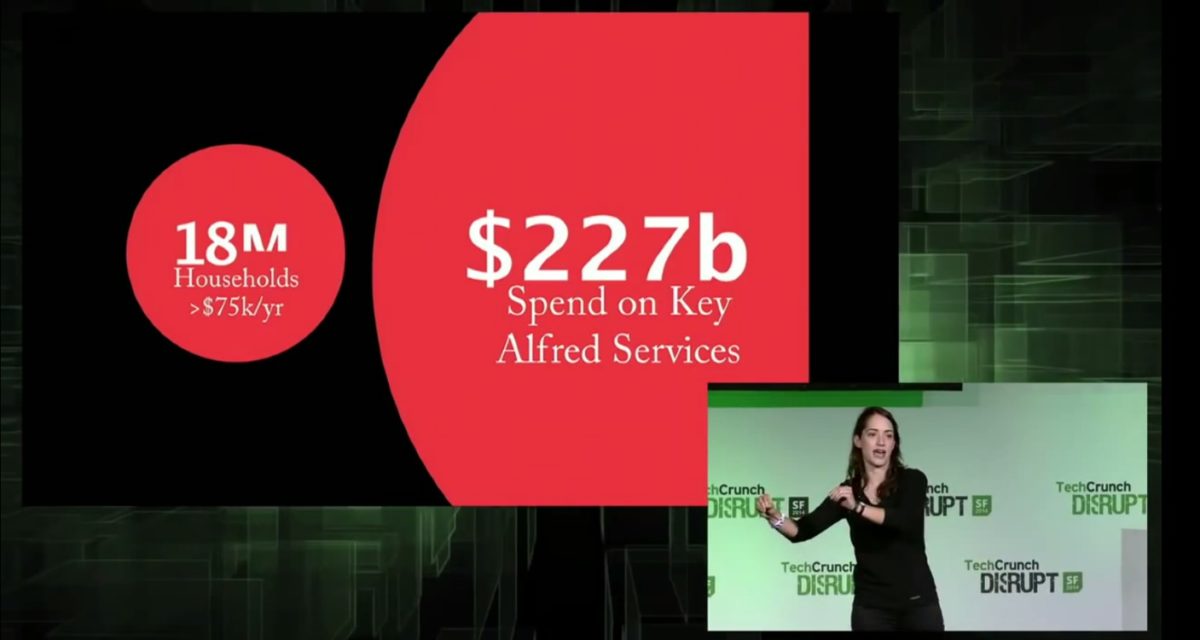
Alfred, start-up winner of the Techrunch Disrupt 2014, ascertains the market size this way.
There are 18 million home owners in the first 10 towns that have this service, and are already paying more than €227 billion for the home services on which Alfred relies.
The on-demand services are spreading all over the world and, where on-demand home services are available, we represent the natural consequence.
Business Model
If an investor is putting money into your startup, they’re expecting a good return—simple as that.
Therefore, it is natural to close saying that your solution shall generate an economic value and so must have a solid and preferably scalable business model.
So, in this section you shall answer this brutal and simple question:” How do you actually make money from this idea?”.
In the case of PI Inc, the founder (who won the Techrunch Disrupt SF 2017) explains that PI business model consists of two parts.
First, they target end consumers, maintaining a 50% margin and a high customer lifetime value. Second, they explore distribution partnerships with established companies in the consumer electronics sector.

Customer Lifetime Value (LTV) is the total profit a business expects to make from a single customer over the entire time they remain a paying user.
For a business to be sustainable, LTV should always be higher than Customer Acquisition Cost (CAC)—meaning the money you earn from a customer should exceed what you spent to acquire them (marketing, sales, ads, etc.).
But here’s the catch: acquiring customers isn’t enough if you can’t keep them. This is where churn rate comes in—it measures how many customers stop paying for your product or service over a given period.
Let’s break it down with an example.
Imagine you see a gym ad on TV, check out their social media, and finally decide to go for a free trial. A trainer gives you a tour, helps you with your first workout, and convinces you to sign up.
But after one month, you cancel your membership.
Now, think about it: how many months would you have needed to stay for the gym to recover the cost of acquiring you?
Between ads, promotions, staff time, and special offers, they likely needed more than one month of membership fees to break even. Since you left after 30 days, they lost money on you.
This is why acquisition alone isn’t enough—if customers churn too quickly, all that marketing spend goes to waste.
Bottom line? Keep an eye on your churn rate. If you can’t retain customers, your business model won’t work—no matter how many people you bring in.
In the case of Airbnb, this business model is mixed in a slide together with some market metrics.
The slide goal is to show an estimate of potential revenues projected into 2011.
In this slide, the business model would be, “We are retaining 10% of commission on any transaction”.

The business model sentence explains the company’s model to generate revenue. In addition, it is well summarized and easy to understand.
A simple and brief sentence that speaks clearly to the investors is all you need inside a business model slide.
Traction
I think that any entrepreneur, in his life, has to take one of the most over-used answers from an investor:” Not a bad idea, come back when you have more traction.”
Traction is, for sure, one of the most used words by VC. But it is also an abbreviation that people use to talk about the grip of a project on the market. Many investors could ask you for the business model. We believe instead that the traction is the most difficult part to show.
Fred Wilson, Principal, Union Square Ventures
Why are investors so obsessed with traction?
Because traction proves that customers actually want your product—and that makes an investment far less risky.
I get it—this can be frustrating for early-stage startups. But like it or not, traction is the best way to convince investors that your solution or business model actually works.
And what exactly is traction?
It’s real, measurable proof that your business is gaining momentum.
This could be sales numbers, a growing user base, a strong retention rate, revenue trends, or any other key metric that shows your startup is making progress.
Investors don’t just want ideas—they want evidence that your product has demand. Traction is that proof.
In Alfred’s pitch at Techcrunch Disrupt, previously mentioned, there is a moment when Marcela commences:
[…] We know that Alfred works. All these pins represent the active Alfreds in Boston, and the red ones have been with us for more than 10 months, with a retention rate of 90% […].
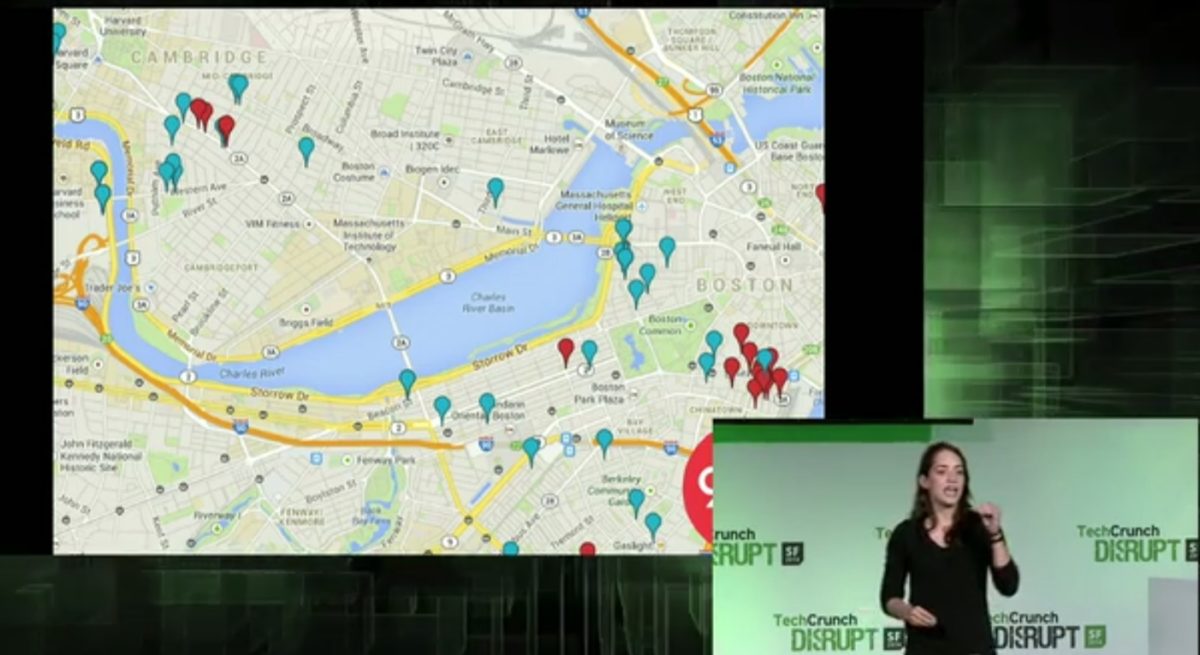
As you see, Marcela has not shown a single figure, but with this chart, she has clearly shown that her service was adopted by the market and that customers are paying in order to access it.
If, for instance, you have a product on pre-sale, and the customers are paying a small amount in advance in order to be awarded the product you have just launched, then you can say to have the first signs of traction.
As you can see, the product doesn’t even exist yet. At this stage, you might have nothing more than a pre-sale page, which isn’t a full representation of the sales process you’ll eventually build.
But here’s the thing—that could still be enough to convince investors. If people are already showing interest and are willing to pay, it proves there’s demand for your product.
The challenge? Early-stage startups often struggle to show business metrics because the product or service hasn’t been launched yet.
Be this the case, I suggest you to thoroughly follow the methodology shown in The Lean Startup written by Eric Ries (Note: the bible for every person that wants to create a business enterprise).
You should focus on running tests, making the most of your resources, and building a Minimum Viable Product (MVP)—something simple but functional enough to prove that your solution works.
Once you have an MVP, start gathering early feedback and data. Even if you don’t have solid business metrics yet, these first signs of interest can help validate your idea and demonstrate its potential to investors.
An MVP is essentially a basic version of your product—it includes only the core features needed to test whether your solution meets the needs of potential customers.
Your goal? Test, measure, and refine. Use your findings to strengthen this key section of your pitch and show that your startup is on the right track.
Competition
One of the most crucial parts of your startup pitch is how you position yourself against the competition.
Imagine this:
Investor: “Who are your competitors?”
Entrepreneur: “We don’t have any—our solution is completely unique!”
Sounds great, right?
Wrong.
If you claim to have no competition, investors will immediately think one of two things:
- You haven’t done your research. It’s highly unlikely that no one else has tried to solve this problem before.
- There’s no real market for your idea. If no one else is tackling this issue, maybe it’s because there isn’t a business opportunity there.
Either way, it’s a red flag. Investors don’t back entrepreneurs who haven’t studied their market or, worse, are building something no one actually needs.
But here’s the good news: competition is a sign of demand. It means there’s already a market for your idea, and if your solution is truly innovative, you have the chance to disrupt that space and carve out your own share.
So instead of pretending your startup exists in a vacuum, use this section of your pitch to show:
- Who else is operating in this space?
- What are they doing well (and where do they fall short)?
- How does your solution stand out?
Investors don’t need you to be the only player in the game. They need to know why you’re the one worth betting on.
Taking as an example the competition slide coming from a Facebook pitch you can notice how the competitors are always shown with no fear but in an intelligent manner.

As a matter of fact, two critical variables are identified for which Facebook is different: the Private dimension and entertainment. Facebook is located in the top right corner in the matrix.
Obviously in the pitch it is up to you, as entrepreneur, to motivate the fact that your positioning has the right potential to conquer the market in the most effective/efficient way than your active competitors.
Another interesting consideration concerns the overseas competitors.
If a startup with a similar model is thriving in another country with comparable market conditions, that’s a strong signal that your idea has potential. Investors love this approach because it reduces perceived risk—you’re not just guessing, you’re showing that a proven model can work in your target market too.
At the end of the day, it’s not about being the only player in the game—it’s about being the one that plays it best.
Having competitors is a healthy thing for a company; it means that you are heading the right way.
This is the reason why you should always show your ranking compared to competitors.
In the introduction and launch of the first iPhone in 2007, Steve Jobs said:
Telephones on the market today are not smart, and are absolutely not easy to use. The smartphones are a bit too smart, but are not easy to use because of their plastic keyboard. We have invented a smart telephone, extremely easy to use.

The way he introduced the iPhone is direct, and very effective too. Without figures and complex charts, Steve Jobs identified the strongest diversification points of his new product, and placed it in relation to all the others.
In the case of telephones, everyone knew the competitors at the time, and everyone knew the existence of mobile phones, so this matrix was easy to understand.
However, the most interesting thing is that it makes it plain how the market is structured, and why this product is unique compared to the others.
As you can see, Jobs was not scared to show a very populated market. He did not invent the phone, he reinvented it!
Go to Market
Even the best product or service will fail if people don’t know it exists or don’t see a reason to use it.
I’ve lost count of how many times I’ve heard entrepreneurs say, “Once we launch, people will flood to our website—it’s that good!” Only to watch them stare at an empty analytics dashboard, wondering what went wrong.
Developing a great product is just one piece of the puzzle. The real challenge is getting it into the hands of customers.
And this is where many startups struggle—and fail.
The truth is, no one has a perfect go-to-market strategy from day one. It’s a process of testing, learning, and adjusting. But here’s the catch: trial and error is expensive, and if you burn through your budget before figuring it out, your startup won’t survive long enough to succeed.
The ability to break into the market effectively has always been a defining factor between startups that thrive and those that disappear.
So the real question is: How do you make sure people not only discover your product but actually want to buy it?
Think of Google that when was born was certainly not alone, among its competitors there were some already working to solve the same problem. Then Google came out and maybe we have a distant memory of all the other ones nowadays.

How do you intend so to develop your idea’s marketing strategy?
One of the best examples to make the point comes from the Airbnb pitch deck.

In the Go-to-market section, what they call adoption strategy presents three market approach strategies:
- The first one is connecting to accommodate tourists on the occasion of great events.
- The second one exploits strategic partnerships.
- The third strategy is the Go-to-market technique that has become famous as one of the most brilliant growth hacks in the history of digital start-up.
When Airbnb first started, its biggest challenge was balancing supply and demand.
Getting hosts to list their apartments was relatively easy—it only took a few clicks. The real struggle? Attracting travelers who were looking for an alternative to hotels.
At the time, Craigslist was one of the go-to platforms for short-term rentals. Homeowners would post their listings, and travelers would browse the site looking for a place to stay. But Craigslist didn’t manage transactions—it was just a huge, unstructured marketplace with tons of users and zero built-in booking system.
Airbnb saw an opportunity.
They built an algorithm that automatically cross-posted listings from Airbnb to Craigslist. Each post included a direct link back to Airbnb, so travelers browsing Craigslist would end up on Airbnb’s platform to complete the booking.
In short, they hijacked Craigslist’s traffic and funneled it straight to Airbnb.
This clever growth hack gave Airbnb an explosive boost, and by the time Craigslist caught on and blocked the workaround, Airbnb had already gained massive traction.
Besides the fact that this story is extremely fascinating from my viewpoint, and I am inviting you to look into it further online, the reason I tell you that is to show you that you will rarely find a standard Go-to-market that someone else has realized, and that you can simply replicate for success.
Because there’s no universal go-to-market strategy that guarantees success. What worked for one company may not work for another.
Your market, timing, team, and competition all play a role. The only way to find your winning strategy is through constant testing, measuring, and adapting.
That’s exactly what Airbnb did: they identified a gap, exploited an opportunity, and adapted as they grew.
Your job? Figure out your own unique way to break into the market.
Team

Holy words, thanks Ed!
We often hear said that people make the difference and this is true even more in the entrepreneurial projects with high innovation impact.
A good team consists of professionals that have complementary abilities.
For instance, if you are developing a webapp, you may have someone that is taking care of the business development and someone else that takes care of the technical development.
This way you will have someone that takes care of creating the webapp, programming it, and who takes care of attracting traffic and develop the go-to-market.
Clearly, if you are developing a webapp and all the team members have a business profile, no one will be able to develop the solution and so you will have to look for some freelancer help.
So you will keep on burning cash for core activities that shall be developed at home.
I am not saying that you won’t be successful. But I believe that your project will be perceived as being riskier and so considered to be less interesting by the investors.
Trust is key when building a team, but it’s just as important to surround yourself with people who bring the right skills to the table. Investors want to see that your team isn’t just passionate but also capable of executing the vision.
So, how do you present your team in a pitch?
Start by clearly showing who does what and why each member is crucial to the success of the business. Investors need to understand not just the names and titles, but the real value each person brings.
A great example? Buffer’s pitch.

Joel Gascoigne is one of the co-founders and has the ability proven by his expertise, to make the business model work.
My advice is to positively exploits any possible advisors or other investors but maintaining them carefully separated from the operational team.
Finally, let me give you the advice to use photos that would offer a face and personality as well as the character of your team members.
Read also: What makes presentations engaging and how you can do it too
Financial Projections
Planning of the financial resources is crucial for the sustainment of the business in the middle and long run.
All the companies that fail have a common cause of failure: they have exhausted their financial resources
Don Valentine, Sequoia Capital
Entrepreneurs should have the ability to plan their business to manage it in a rational manner with a long period perspective, to not be influenced by everyday events, and to make the company look interesting to the investors’ eyes.
Calculating the financial forecasts requires time, and to maintain them, you will need it time again—especially when following the quick evolution dynamics of a start-up.
If you are thinking of the big table of the profits account, projected in 5 years, you are quite wrong!

Of course, you need to carefully prepare your financial projections, but your pitch is not the place to overwhelm investors with endless numbers.
Here’s why:
- Investors are experts at analyzing financials—often more than entrepreneurs. If you overload them with numbers, expect sharp questions that could derail your presentation.
- In a high-pressure pitch, it’s easy to forget specific details behind your calculations. If you stumble while explaining them, you risk looking unprepared—even if your numbers are solid.
Instead, focus on the big picture: your business ambition and potential.
Your financial projections should demonstrate the scale of your opportunity—not get lost in minor details. Investors already assume that early-stage estimates are optimistic, so they’ll mentally adjust them.
Be ambitious, but stay grounded. There’s a fine line between a bold vision and unrealistic expectations.
One of the best ways to present this?
An EBITDA chart.

This is one of the features your financial plan should meet.
Long-term financial projections are rarely accurate, but they help investors understand the scale of your ambition.
Now, imagine you present a startup forecasting €80K in revenue by year five, but with four years of losses before breaking even. That’s a tough sell for investors. Why?
- The growth is too slow to make the risk worthwhile.
- The financial upside is too limited—it doesn’t suggest a high return on investment.
But there’s another key factor at play: investors assume that your estimates are already optimistic. They know that founders tend to present best-case scenarios, so they mentally adjust projections downward to account for real-world challenges.
This means that if you pitch conservative numbers, investors might think the reality will be even worse—making your startup look like an even weaker bet.
Investors think in terms of potential. Research shows that large numbers (even when risky) are more compelling than cautious, small-scale projections. A startup aiming for millions in revenue will grab attention faster than one projecting slow, steady growth—even if both come with uncertainties.
That doesn’t mean you should inflate your numbers unrealistically, but you do need to show an ambitious yet achievable financial path.
And don’t forget to clearly state when you expect to reach break-even.
Yes, investors are drawn to ambitious numbers, but they also want to know how and when your business becomes sustainable. Showing a realistic timeline for profitability helps reduce their perceived risk.

One last tip: when presenting your financials, don’t get bogged down in excessive details. You don’t want investors stuck on a slide full of complex projections, nitpicking every assumption. Your goal is to keep the momentum of the pitch, not get lost in a financial deep dive. Your goal consists of finishing the presentation as fast as possible.
Avoid projecting all the details with a table, and it will also help you avoid uncomfortable questions.
My advice is to keep the slide with the table either hidden or held as backup (recommended read: The definitive guide to presenting data in PowerPoint).
It could be useful if, having finished the presentation, more detailed questions are asked of you.
The Startup Pitch Structure End Goal: Fund Raising Request
Making an excellent presentation means getting to the end really involving the audience and being so ready to advance the request to adopt your idea and, in the event of a pitch for doing financial fund raising.
Think of it like an Amazon checkout page. Your pitch leads investors through the journey, and now they’re at the final step: will they “buy” into your vision?
But here’s the reality—rarely does a single pitch secure funding on the spot.
What it does do, however, is open the door. A strong pitch gets investors interested enough to ask more questions, schedule follow-ups, and seriously consider your business.
If you have worked well so far, this is the moment of advancing the financing request showing the amount you are looking for, the progress report of the fund raising, and the allocations envisaged by the required funds.

For example, Fittr’s slide clearly shows the application, and then lists how the funding collected will be invested.

My suggestion is to add another step and show the allocation percentages. This way, you will show the balance with which you will allocate the funding, giving a different importance to the various parts.

Always remember to end any presentation with an explicit request.
After all, if you showed it to some people you have done that because you wanted them to do something. So never forget to ask them that.
If you won’t need upcoming funding or if you are simply looking for something else, like for instance a strategic partnership, do not hesitate to request that explicitly.
Remember that all the efforts you have made so far will only have been done to position yourself in the best conditions to advance such request.
Roadmap
One of the investors greatest worries is to follow the trend of his investments portfolio. After all, they’re not just investing their own money—they also have to report back to their own investors.
This makes their job tricky. Every startup moves at a different pace, with unique metrics and challenges. That’s why setting clear expectations and committing to key milestones can help reassure investors and strengthen your pitch..
A great way to do this? Use a timeline-style roadmap, but keep it focused.
Avoid presenting a twenty years roadmap when you well know that in a startup even one year can completely overturn your business performance.
Buffer, in a very simple way, has combined products development elements (Launch of the web app, launch of the API) with the users growth and the impact on revenue.

This slide highlights an important strategic move: by launching the API, the product can be integrated with external applications, with the goal of reaching 50 integrations by December 2011.
The expected impact? 100K users and $288K in revenue by 2012, setting the stage for even more aggressive growth in the following years.
A detail worth noting: some dates are marked in grey, others in green. This likely indicates that some milestones have already been reached, while others are still in progress.
Visually distinguishing achieved vs. upcoming goals is a smart move. It makes the startup’s progress feel tangible and credible, reinforcing the idea that future milestones are not just aspirations, but the natural next steps in a proven growth trajectory.
Create an Excellent Pitch Deck with This Startup Pitch Structure
Then importance of communicating your project with an effective presentation is vital. Do not overlook the pitching activity because it is one of the few activities that you won’t be able to delegate.
In order to create an effective pitch, it won’t be sufficient to be good at PowerPoint. Behind a pitch presentation of a project as you saw there are many challenges to overcome.
Prepare yourself for improve your public speaking and use this article to fill up your presentation in an orderly way and with the right level of contents.
See you!
Sources
Startup pitch deck: the ultimate guide to create a brilliant startup pitch presentation
Airbnb – The growth story unveiled
The neuroscience of investing: fMRI of the reward system
Startup pitch structure: FAQ
How should a startup pitch be structured to attract investors?
A successful startup pitch relies on three key pillars: the content (what you say and what you leave out), the order of presentation (what you say first), and the design that brings your message to life. It’s crucial to provide investors with the necessary information concisely and engagingly while capturing their attention from the very start.
Why is it important to start a pitch by addressing the problem?
Investors are driven by personal interest and want to immediately understand why they should care about your proposal. Starting with a clear articulation of the problem helps establish a connection with your audience and highlights the market opportunity your startup is addressing. Without a compelling problem, your proposed solution may fail to generate investor interest.
What is the role of storytelling in a startup pitch?
Storytelling is a powerful tool in a startup pitch because it makes your presentation more engaging, relatable, and memorable. A strong narrative helps investors connect emotionally to the problem you are solving, making them more invested in your solution. By structuring your pitch as a story—with a clear setup, conflict, and resolution—you can keep your audience’s attention and increase the chances of securing funding.
Get the PDF now!


Comments on The ultimate startup pitch structure to present your idea and get funded