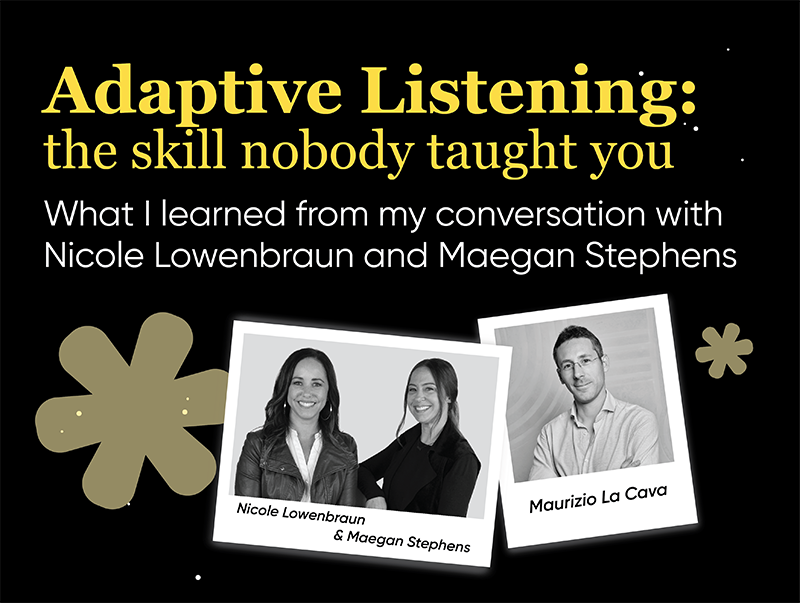
What I learned from my conversation with Nicole Lowenbraun and Maegan Stephens of Duarte, authors of the S.A.I.D. framework

Key Takeaways:
• Listening must adapt to the moment: There isn’t one right way to listen. Effectiveness depends on what the other person needs right now. Strong communicators adjust their style in real time.
• Active listening isn’t enough anymore: Built for therapy, it doesn’t fit fast-paced work environments. Modern listening requires flexibility, including challenging and deciding when needed.
• S.A.I.D. = four listening styles: Support (empathy), Advance (action), Immerse (understanding), Discern (analysis). The key is not your default, but your ability to switch between them.
• Great listening goes beyond words: It includes reading tone, body language, and what’s not being said. This helps you respond to the real need, not just the spoken message.
• Adaptive listening is a leadership advantage: Teams sometimes need to feel heard. Leaders who adapt their listening build trust and make better decisions.
How many times have you left a meeting feeling that something was off? Not because of what was said, but because of how it was heard. It is a subtle feeling, hard to articulate, yet it has an enormous impact on the quality of decisions, relationships, and organizational culture.
I had the pleasure of interviewing Nicole Lowenbraun and Maegan Stephens, two professionals at Duarte, one of the most important communication agencies in the world. Together they wrote Adaptive Listening, a book that is changing the way we think about listening in the professional context. After reading it and speaking with them at length, I can say this is one of those pieces of work that makes you rethink how you operate every single day.
How Adaptive Listening Was Born
The story is fascinating because, as often happens with the best insights, it did not come from a planned project. Nicole and Maegan were working as speaker coaches at Duarte, helping leaders and professionals communicate better on stage. One day, during a break in a training session, they looked at each other and said: we call ourselves a communication firm, but we don’t do listening. And listening is the whole other half of communication.
That thought lingered for years, until two events made it explode. The first: Maegan left a client call with a colleague and they ended up with completely different interpretations of what had been said. Both had listened, both had taken notes, but they had understood different things. The second: the pandemic. In 2020, with empty calendars and a need to make their time meaningful, Maegan sent Nicole a text: let’s build a course about listening. A secret project, born out of passion, that eventually became a book published by one of the most influential voices in the world of communication.
Why Active Listening Is No Longer Enough
One of the most interesting points that emerged from our conversation concerns the relationship with active listening, a concept we all know and many take for granted. Nicole put it very directly: active listening was created in the 1950s for therapists and counselors. It was never designed for our hectic workdays, packed with back-to-back meetings and rapid-fire decisions.
The principles of active listening (don’t interrupt, don’t judge, summarize) work in a therapeutic setting. But in the workplace? Sometimes interrupting is necessary to fuel a brainstorm. Sometimes judging is exactly what you were hired to do. If we had to summarize every conversation, our work would slow down to an unsustainable pace.
The baseline remains valid: pay attention, put your phone down, be present. But Adaptive Listening goes further. It asks: what does this person need from me, right now, in this moment?
The S.A.I.D. Framework: Four Listening Styles
At the heart of the book is the S.A.I.D. framework, an acronym representing four listening styles, each with specific strengths and pitfalls.
Support: listeners with this style focus on the person. They want every voice to be heard, every emotion to be validated. They are the colleagues who make sure nobody gets left out of the conversation. The risk? Holding back their own contribution or failing to move the discussion forward when needed.
Advance: the action-oriented listener. They process what they hear by immediately thinking about what needs to happen next, how to unblock the situation, how to drive the group toward a decision. Maegan identified herself in this style. The risk? Pushing too fast when the group is not ready, or coming across as impatient.
Immerse: the style closest to traditional active listening. Immerse listeners aim to understand and remember. They are the ones taking detailed notes, cataloguing information. Essential in situations like onboarding or a technical briefing. The risk? Stalling the momentum of the conversation or appearing disengaged.
Discern: the listener who evaluates, analyzes, and critiques. Nicole places herself here: her natural instinct is to spot issues and potential problems. Invaluable when thoughtful decisions are needed. The risk? Being perceived as negative or slowing down processes that require speed.
Each of us has a dominant style, our own default. The key is not to cling to it, but to recognize it so you can adapt to what the situation requires. This is the crucial shift: your style is not an identity to be proud of. It is a starting point from which you learn to pivot.

Listening to What Hasn’t Been Said
One concept that struck me particularly is listening to what is not verbalized. Maegan shared a perfect example: she was working with a Fortune 50 executive to build a strategic framework. One day, the client walked into the meeting and told her he had written the whole thing himself the night before. Maegan could have simply read it and commented. Instead, she paused and asked him: what do you need from me right now? Do you want me to tell you whether it works? Add to it? Or do you think it is ready to ship as is?
He froze. He had not even thought about it. That is what it means to listen to what has not been said: reading body language, picking up on someone’s energy, and above all asking yourself what your role is in that specific moment. When expectations are violated, when a conversation takes a different turn from what you anticipated, that is where adaptive listening makes the difference.
Why the Book Is Structured in Two Parts
The book is divided into two sections, and it is a deliberate and smart choice. The first part is a journey of self-discovery: you learn how you listen, what your dominant style is, and where your blind spots lie. There is also a self-assessment test (which I highly recommend taking: the result might surprise you, as it surprised me).
The second part shifts perspective: it is no longer about how you listen, but about how others need you to listen. This is where the framework becomes operational. For each listening style, the authors map out real-world situations, offer concrete tactics, and guide you in recognizing the signals that indicate which type of listening the moment calls for.
As Nicole explained: you cannot adapt if you don’t first know where you are starting from. You have to understand your default in order to move beyond it. It is the same principle we apply when working on presentations: first you understand your starting point, then you build the path toward your audience.

Listening as a Leadership Skill
One of the most powerful moments in the interview was about leadership. The authors shared the case of Nancy Duarte, the agency’s CEO, who adopted the framework firsthand. Nancy is an Advance/Discern listener by default: her instinct always pushes her toward the next decision and toward critical evaluation. When her team returned from vacation and updated her on what they had accomplished, she would immediately respond with actions and assessments, when in reality the team simply needed to be listened to in Immerse and Support mode.
Since Duarte’s executive team started sharing the language of Adaptive Listening, meetings now begin with a simple yet transformative question: how would you like me to listen today? This changes everything. It shifts dynamics, reduces friction, speeds up decisions when needed, and slows them down when reflection is more valuable.
And here is an observation I fully agree with: leaders tend to default to the Advance style. It is understandable, as their role pushes them toward decisions. But the team does not always need a decision-maker. Sometimes it needs someone who truly listens. The difference between a good leader and a great leader lies precisely in this ability to adapt.
Why Nobody Teaches Us How to Listen
There is a deep reason why we invest so much in speaking and so little in listening. Maegan explained it with an effective metaphor: you do not train yourself to walk better if you have been walking since you were born. You do not practice more efficient chewing. Listening falls into the same category: we have been doing it forever, so we assume we are good at it.
Public speaking, on the other hand, triggers anxiety, it puts your face on the line. That is why millions have been invested in expressive communication training. But who has ever received feedback on the quality of their listening? At best, a single line in an annual review. Nobody holds us accountable for how we listen. And until we have a concrete model that is easy to remember and immediately applicable, we will keep not doing it.
Can Adaptive Listening Be Weaponized?
I asked this question deliberately, because every powerful communication framework carries the risk of being used instrumentally. Maegan’s answer was pragmatic and honest: yes, theoretically someone could fake adaptive listening to gain a personal advantage. But the very mechanism of the framework requires you to ask yourself what the other person needs, and the simple act of asking that question repeatedly tends to generate genuine empathy over time.
Nicole added a subtle but important point: the real risk is not manipulation, but pride in your own style. Discovering you are a Discern listener and clinging to that identity as if it were a badge. The whole point of Adaptive Listening is the opposite: if you are doing it well, nobody should be able to guess your default style. Because you are continuously adapting.
Listening as the Last Truly Human Competitive Advantage
The final question in the interview touched on artificial intelligence. AI is getting better and better at generating what we need to say. But listening requires something AI does not yet have: the ability to read a micro-expression in real time, a shift in tone, a silence. A human can pick up on what is not being said and react instantly. AI needs an input. If you do not provide one, it cannot do anything.
As Maegan put it: we do not function purely on logic. We are emotional creatures who make decisions for reasons that have nothing to do with logic. And that is not yet coded into an algorithm. Those who invest right now in sharpening their listening skills are building a competitive gap that AI cannot close. Not against AI, but alongside it.

Conclusions: From Passive Listening to Strategic Listening
For years I have been working on presentations and on the way people communicate their ideas. I have always said that a presentation is not a monologue: it is a moment of listening. Reading the audience, adapting to reactions, understanding what is not being said. After reading Adaptive Listening and speaking with Nicole and Maegan, I have a confirmation: effective communication does not start with the speaker, it starts with the listener. And now we have a concrete framework to do it better.
The S.A.I.D. framework is not a theoretical model. It is an operational tool you can start using in your very next meeting. Recognize your default style, observe what the person in front of you needs, and adapt. If you are a leader, this skill is even more critical: your team members will never tell you that you are not listening to them the right way. It is up to you to figure it out.
In an era where artificial intelligence is automating more and more of our expressive communication, adaptive listening represents one of the few authentically human skills that can make a real difference in business and professional relationships. It is not a soft skill to be relegated to annual reviews: it is a genuine competitive advantage, measurable in team results, decision quality, and the strength of professional relationships.
The book is packed with real stories, concrete situations, and immediately actionable tools. It is not theory: it is an operating manual for anyone who works with people. And if you think about it, who does not? If you want to improve your meetings, your professional relationships, and your ability to lead a team, I recommend starting right here.
FAQ – Frequently Asked Questions
What is Adaptive Listening?
Adaptive Listening is an approach to listening developed by Nicole Lowenbraun and Maegan Stephens of Duarte. Unlike traditional active listening, it does not propose a single way to listen. Instead, it teaches you to recognize four different styles (Support, Advance, Immerse, Discern) and to adapt in real time to what the speaker needs in any given moment.
What is the difference between Active Listening and Adaptive Listening?
Active Listening was created in the 1950s for therapists and counselors, built on principles such as not interrupting, not judging, and summarizing. Adaptive Listening recognizes that in the workplace these rules do not always apply: sometimes interrupting fuels a brainstorm, sometimes judging is exactly what you were hired for. Adaptive Listening starts from one question: what does this person need from me, right now?
What does S.A.I.D. stand for in the Adaptive Listening framework?
S.A.I.D. is the acronym for the four listening styles: Support (focusing on the person’s emotions), Advance (driving toward action and next steps), Immerse (understanding and retaining information), and Discern (evaluating, analyzing, and offering a critical perspective). Each of us has a dominant style, but the key is learning to deploy all four depending on the situation.
Why is listening important for leaders?
Leaders tend to default to the Advance style: they push toward decisions and actions. But the team does not always need a decision-maker. Sometimes it needs emotional validation (Support), sometimes it needs someone who simply listens and remembers (Immerse). A leader’s ability to adapt their listening style directly impacts team trust, decision quality, and organizational culture.
How can I find out my listening style?
The book Adaptive Listening includes a self-assessment test that helps you identify your dominant S.A.I.D. style. This is a crucial step: knowing your default is the first move toward learning to adapt. The result might surprise you, as it surprised me.
Does Adaptive Listening work for presentations too?
Absolutely. An effective presentation is not a monologue: it is a moment of active audience listening. Reading reactions, picking up on body language, understanding when your message is landing and when it is not. The S.A.I.D. framework provides a lens to interpret these signals and adapt your communication in real time, exactly as you would when listening in a conversation.
Can artificial intelligence replace human listening?
Not yet, and likely not anytime soon. AI excels at generating content and processing information, but it is not capable of reading micro-expressions, tonal shifts, silences, and emotional cues in real time. Adaptive listening requires empathy, intuition, and the ability to react to what is not being said. For now, this remains an exclusively human skill and a genuine competitive advantage.
How can I implement Adaptive Listening in my team?
You can start in three ways. First: identify your own listening style and observe how it impacts your interactions. Second: before an important meeting, ask yourself what the people you will be talking to actually need. Third: if possible, share the S.A.I.D. language with your team. When everyone knows the four styles, it becomes possible to open meetings with a simple yet powerful question: how would you like me to listen today?


Comments on Adaptive Listening: The Skill Nobody Taught You (And Why It Matters More Than Ever)