
Key Takeaways:
• AI Fluency vs AI Literacy: AI Literacy refers to the basic understanding of tools, while AI Fluency involves a strategy to effectively interact with artificial intelligence, combining human intuition and computational power.
• The great adoption misunderstanding: Investing in AI is not enough; a company culture must be created that integrates AI as a strategic tool, not just a technical one.
• The 4 Phases of AI Fluency:
- Awareness: Understand AI and its potential.
- Approach: Learn how to properly formulate questions to get useful answers.
- Application: Integrate AI into daily workflows.
- Advocacy: Spread AI culture within the company.
• The role of the human: Despite AI, the final responsibility always remains human. AI Fluency is the ability to use AI to improve effectiveness while maintaining the human contribution.
• Culture and integration: AI must be integrated into business processes and adopted as a competitive advantage through continuous training.
Artificial intelligence is the investment of the moment, there is no doubt, any leader today would approve investments to support their organization’s transition to an AI-driven version of it. When it comes to ROI, however, no one is ready to take responsibility.
We are therefore in a rather strange situation; on the one hand, investments in Artificial Intelligence are reaching record figures: Enterprise licenses purchased by the thousands (Microsoft Copilot, ChatGPT Enterprise, Gemini), global rollout plans and the promise of doubled productivity. On the other hand, if you enter the offices and look at the monitors, the reality is different: AI is used little, badly or secretly (Shadow AI).
Why does this happen?
Because we are confusing the purchase of a technology with the adoption of a culture.
I call it “The Great Misunderstanding of Adoption”, and it was the intuition that started my latest publishing adventure. Thinking that installing software on employees’ computers automatically makes them smarter or more productive. This is not the case. AI is not an update of Excel or PowerPoint (which is often ignored anyway); it is a new way of coordinating thought.
To win in the knowledge economy, you don’t need to teach people to press buttons better (AI Literacy). We need to teach them to think together with the machine. AI Fluency is needed.
In this article, I’ll explain exactly what it is and guide you through the AI Fluency Framework: the 4-step model I use with corporations to transform technological hype into structural competitive advantage.
Literacy vs Fluency: The Difference Between Knowing and Knowing How
For years, we have been told that we must become “digitally literate”. AI Literacy is just that: understanding how the tool works. It is knowing what an LLM is, how to log in, how to open a new chat, where to type a prompt, etc.
But in a business context, Literacy alone has a limit that no one talks about, which is a bit of an elephant in the room of the artificial intelligence era. Every training, webinar, or educational initiative that shows us how AI can change our world excites us a lot. Then we try, and our expectations are disregarded. Moral of the story: very high dropout rate and no change.
We all go back to working as before, to using AI badly, unconsciously, and above all, unsafely, uploading company data into LLMs from which we should stay away.
I’m leaving, right now, from a call with a client tired of doing courses on AI because they don’t change anything. We need to go beyond AI literacy.
AI Fluency is a higher level. It is not technical; it is strategic. Being AI Fluent means orchestrating a continuous dialogue between your intuition and the computing power of the machine. It means:
- Understand the context: Know when to use AI and when the human brain is indispensable.
- Ask the right question: AI doesn’t know our context or know what might be right or wrong for us. To guide AI towards the most effective output, you need to know how to formulate the right question in the right way.
- Handle error: Know that generative AI works on a probabilistic, not deterministic, basis. “Hallucinations” are not bugs; they are a feature of the creativity of the machine that must be governed.
- Maintain accountability: AI proposes, you dispose. Cognitive “autopilot” is the number one enemy of quality.

when to use AI and when it is better to do without it.
The MLC AI Fluency Framework: A 4-Step Method
In my experience working in contact with large organizations (see this AI Adoption project in Lactalis), I have observed a recurring pattern. Initiatives that are limited to providing operational tools or skills generate sporadic use but not transformation. Those that also address the cultural, methodological and organizational dimensions are instead able to build a bigger and more lasting change. It is not a question of doing more, but of following a correct order.
From this observation, the MLC AI Fluency Framework was born. It is not a list of good practices or a guide to the tools of the moment. It is a maturity model articulated in four progressive phases, each of which solves a specific adoption problem. The phases are not interchangeable and cannot be compressed without generating fragility in the system. Each step prepares the next and makes possible what would otherwise remain an isolated attempt.

The model accompanies people from understanding the nature of AI to the ability to interact with it methodically, from integration into daily processes to cultural dissemination within the organization. Only when these four dimensions are addressed coherently and sequentially does AI cease to be a technological initiative and become a collective competence.
At MLC, we have created a workshop aimed at developing AI Fluency in structured, large organizations.

Let’s get into the MLC AI Fluency model. The four phases are Awareness, Approach, Application, and Advocacy. Each represents a growing level of maturity and, at the same time, a concrete response to an obstacle that today prevents organizations from transforming AI into a stable competitive advantage.
1. AWARENESS – Understanding

Practically every day, a new model emerges, a new integration, a new promise of productivity. Managers read articles, are bombarded with webinars, podcasts (if they find the time), newsletters, and social feeds that now talk about nothing else. The common feeling, however, is always the same: being late. AI seems to run faster than human ability to understand it.
This run-up generates two opposite but equally ineffective reactions. The first is uncritical enthusiasm: any initiative is approved as long as it “has AI inside”. The second is defensive paralysis: it is better to wait until the picture is clearer. In both cases, one essential thing is missing: a stable cognitive map.
The problem is not the absence of information. It is the absence of structure.
What is the difference between ChatGPT and Claude? Is it true that Google Gemini is the best just because it has the widest context window for the time being? Is Microsoft Copilot really as far behind as everyone thinks, or does it have advantages? Why can’t I use anything else in the company but this Microsoft Copilot? What does it mean that information is not secure in ChatGPT?
These are just example questions, which many managers ask themselves, and to which it is not easy to find a concrete answer, and even if it were, it could change at any moment.
The Awareness phase was created to solve this problem. You don’t need to know every new tool. We need to understand the nature of the phenomenon. First, I like to share the story of modern AI and how the arrival of generative AI has been a game-changer. Understanding history also helps to give a temporal collocation of the birth of AI Companies and the different paths they have taken. In this vein, it will be natural to illustrate and distinguish the main instruments on the market.
Afterwards, I like to talk about terminology. Like any specific domain of expertise, AI also has its “bad words”: Rack, Transformer, LLM, Prompt, GPU, Context, etc.

And then, out of curiosity, you who are reading these lines, would you be able to answer me straight away if I asked you the meaning of GPT?

Another recurring question is related to why we should use compliant systems, such as, for example, Microsoft Copilot, in the company, even when it seems to us that ChatGPT works better.
In a simplistic version, to answer the question, I could tell you that Copilot is Microsoft, the company that, with good probability, has been managing all the data in your organization for years.
So, do we have to settle for a poor AI system? Then we prefer to use GPT secretly.
In reality, Microsoft Copilot (see my mini course on Microsoft Copilot) is a powerful tool with capabilities that allow us to do much more than what a manager needs in the daily routine.
Only when technology stops being perceived as magic or a threat does it become manageable.
In short, in this first step of the AI Fluency pyramid, we aim to bring everyone to the same level of awareness, equip them with the right technical vocabulary, history, and all the latest updates to fully understand the AI phenomenon and the impacts on their work, and, why not, even on a personal level.
Awareness counteracts the feeling of being late and gives a feeling of relief because, suddenly, everything we have heard about AI is contextualized and explained to us so that we can really understand its potential.
2. APPROACH – Dialogue methodically

A manager asks the AI for a market analysis. He receives an orderly, convincing, well-written document. Forwards it to the team. After a few days, inaccuracies, generalizations, and non-existent sources emerge. The reaction is immediate: “AI is not reliable”.
In reality, the problem had arisen earlier. In the formulation of the question and in the interpretation of the answer.
I like to imagine AI as a black box that interposes, as a processing phase, between the Input and Output phases.
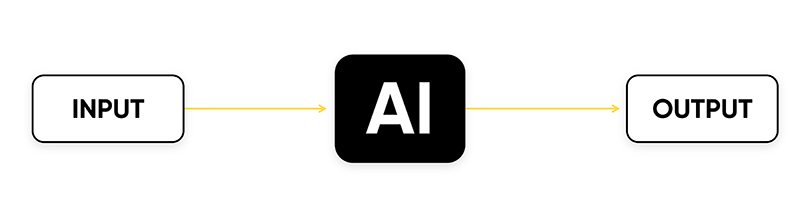
Input and Output are and remain human.
Every interaction with AI is an act of defining the problem. The input is not a technical request but a very clear choice of what information to pass and how to do it. It delimits the context, establishes the objective, determines the expected level of depth. If the question is vague, the answer will be plausible but generic. If the perimeter is ambiguous, the output will be ambiguous as well.

The input is divided into three basic parts:
- Context: information relating to our specific context, so that AI can enter our world and act on equal information
- Methodology: if you don’t want AI to choose the path to follow, it is good to delimit the scope of action. Sharing a methodology to follow allows you to improve the quality of the expected output by driving and not following AI
- Alignment: AI doesn’t know what’s right or wrong; we have to tell it. What does it mean to find the best restaurant, or to create an effective presentation? For whom, in what context, in how much time, in what location, etc.
Once the key information has been defined, we need to provide it to the AI in a language that is suitable for the machines. Have you already guessed that I’m talking about prompting?
But how do you write an effective prompt? Here we could quibble for days, but to get straight to the point, I did a cross-model analysis in which I questioned all the main LLMs by asking them all the same question: “What is the most effective structure to write a prompt?” (The real prompt was more complex, but to explain this is more than enough).

Analyzing them horizontally (cross-model), you immediately notice that there are similarities and that the key components of a prompt emerge more often.

Looking for the leanest structure and therefore the one that minimizes the input and maximizes the effectiveness of the output, I decided to use only a few key components: objective, context, constraints, examples, and evaluation criteria.

I have consolidated this structure into the MLC Prompting Template that you can download and start using right away.

Remember, a good prompt is a good place to start, if you input good information into the AI, you have more information to extract a higher-quality output.
I did a good prompt, so is it done? Far from it!
Regardless of the quality of the prompt, which is a necessary but not sufficient condition for quality output, we must consider the result, always unreliable. Never trust the outputs that an LLM provides you without first reading them and putting your head into them.

Therefore, copy/paste is definitely prohibited, at least until you have read and agreed to take full responsibility for the content. AI provides answers (right or wrong), but remember, it will never take responsibility for you. So, don’t trust it and check carefully.
The Approach phase introduces discipline in the human-machine dialogue. It means structuring the request by making explicit the role, context, objective, and constraints. It means accepting that the first answer is a draft and that the value emerges in the critical iteration. It means asking the system to highlight limits, propose alternatives, and make implicit assumptions explicit.
Here, a decisive shift takes place: AI is no longer a tool to be interrogated, but an interlocutor to be guided. Competence is not about “making better prompts”, but about reasoning more precisely.
The Approach transforms occasional use into a method by providing you with all the tools to do it in the most effective way. Without this step, any mistakes will be attributed to technology instead of the quality of the demand.
3. APPLICATION – Learn by doing

The company starts an AI project. Some licenses are deployed. Workshops are organized. The participants leave enthusiastic. After three months, real use is sporadic. The workflows have remained unchanged.
This is where most initiatives get stuck.
Experimental evidence shows that generative tools can increase productivity and quality in professional writing tasks. Yet, outside the controlled contexts, the return on investment is often not measurable. The reason is simple: technology is introduced without rethinking processes.
The problem is not the power of the tool. It is the absence of operational integration.
The Application addresses this issue. It starts with real bottlenecks: summaries of long documents, drafting of recurring reports, preparation of meeting summaries, revision of complex texts. AI is inserted where it frees up cognitive time and reduces operational friction, not where it produces demonstrative effects.
But integration also requires a reallocation of responsibilities. If the generation of the draft is automated, the human value shifts to review, validation, contextualization. The flow changes. Metrics change. The way of evaluating quality changes.
The Application is not the use of AI. It’s a workflow transformation. Without this transformation, AI remains an interesting experiment.
At this stage, it is essential to show concrete use cases that are close to users. Users must find themselves there. When I was invited to give a one-day workshop to empower the AI Adoption team for the marketing team of a large company in the dairy world, I created a series of exercises and case studies typical of the corporate marketing world.

The approach was completely different when I found about fifty R&D in the classroom.

If the goal is ROI, then the use must be concrete and recurrent. AI must become part of all our daily activities, and this will not happen until users are convinced that with AI, they will struggle less and achieve better results in their daily work.
4. ADVOCACY – Cultural contagion

In every organization, there is a small group of people who have figured out how to use AI well. They produce better results, work faster, experiment with new use cases. The rest of the company watches from afar.
Individual productivity grows. Organizational culture does not.
This is the last obstacle. Adoption doesn’t scale automatically. Competences remain localized. Internal misalignments, gaps in skills, frustration between those who advance and those who fall behind are created.
The problem is not technical. It is social.
Advocacy introduces an internal dissemination lever through bridge figures: colleagues who have integrated AI into their work and are able to translate the benefit into concrete terms for the team.
After all, everyone knows their job better than anyone else, so if a colleague, a peer, has found a way to use an AI productively in their work, colleagues who don’t use it are likely to have something to learn.
These figures do not impose. They facilitate. They make success stories visible. They formalize effective prompts and create shared assets. They create internal communities of practice. They transform individual enthusiasm into collective learning.
When a colleague shows how they saved two hours a week on a repetitive task, the psychological barrier lowers much more quickly than with any institutional presentation.
Advocacy is the transition from personal competence to organizational culture. It is what allows AI to become a common asset instead of an individual benefit.
Unlike the previous steps, the latter is not taught in a workshop moment but facilitated in subsequent moments. I usually organize webinars dedicated to colleagues who want to share their new way of working.
The Human at the center: “Being there” makes the difference
I close with a concept that is very important to me, discussed in the final chapter of the book: the ability to “Be there” (in the age of AI, being there will make a difference).
In a world where AI can generate infinite content at no cost (text, images, code), the value of a handshake between two people has never been more valuable than it is today. We can have our blood tests read by an LLM and get advice, but before making a serious decision, we still want to look the trusted doctor in the eye and get his approval.
AI provides us with many answers, but does not take responsibility for anything that remains with us.
AI Fluency is not a race to see who uses the most technology. It is the ability to use technology to eliminate the superfluous and maximize effectiveness.
- AI can analyze data, but only you can look your audience in the eye as you tell the story behind that data (see my latest book: Presenting Data with AI).
- AI may suggest strategic options, but the ethical and business responsibility for the final decision remains yours.
Acting in the age of AI means using the car to race, but keeping your hands firmly on the wheel, deciding the destination, and correcting mistakes.
Conclusion
In conclusion, the real obstacle to the effective adoption of AI does not lie in the technology itself, but in the lack of an organizational culture ready to think and act with AI. Too many initiatives fail not because of the absence of tools, but because of the lack of a strategic vision that connects skills, structure and people to the real opportunities offered by artificial intelligence. Research confirms this: without addressing organizational barriers, without building trust in users and without integrating AI into daily processes, companies achieve only superficial and short-lived results.
The AI Fluency Framework is not a simple list of tools, but a gradual path that starts from the initial confusion and leads to the development of solid skills, moving from experiments to real value creation.
Only when AI is truly understood, interrogated, integrated, and scaled within the organization does the technology investment transform from a cost to a lasting competitive advantage.
Ultimately, success in the age of AI depends on people’s ability to “be there”: to combine the effectiveness of the machine with the irreplaceable human contribution of responsibility, empathy, and vision.
FAQ (Frequently Asked Questions)
What is AI Fluency?
AI Fluency is the ability to understand, strategically interact with, and integrate artificial intelligence into decision-making and operational processes in a way that is consistent with business objectives. It is not limited to knowledge of tools, but embraces mastery of the models and processes of collaboration with advanced machines.
Why do many AI initiatives fail?
Most AI projects do not generate measurable value because they lack a clear strategy, integration into workflows, and an understanding of the technical and organizational limitations of AI. Industry research shows that nearly half of businesses abandon AI projects before seeing them in production due to these obstacles.
What is the difference between AI Literacy and AI Fluency?
AI Literacy focuses on the conceptual literacy of tools, while AI Fluency is about the ability to orchestrate a strategic dialogue between human intuition and computational power, managing errors, accountability, and decision-making context.
How long does it take to achieve real adoption?
There is no standard time. Progress depends on organizational culture, data quality, governance, and the ability to redesign processes to incorporate AI in a meaningful way. Organizations that pass the trial phase and move towards operational integration see sustainable benefits.
How is the value of AI measured?
The value of AI is measured in concrete results: reduction of process times, increase in the quality of decisions, cost savings, improvement of customer experience and impact on operational results. These indicators require task-specific metrics and not just general efficiency assessments
Is your organization deploying software licenses or building a culture of thought? If you want to transform AI from cost to investment, you need to stop looking at software and start training people.


Comments on AI Fluency. From technological hype to real competitive advantage